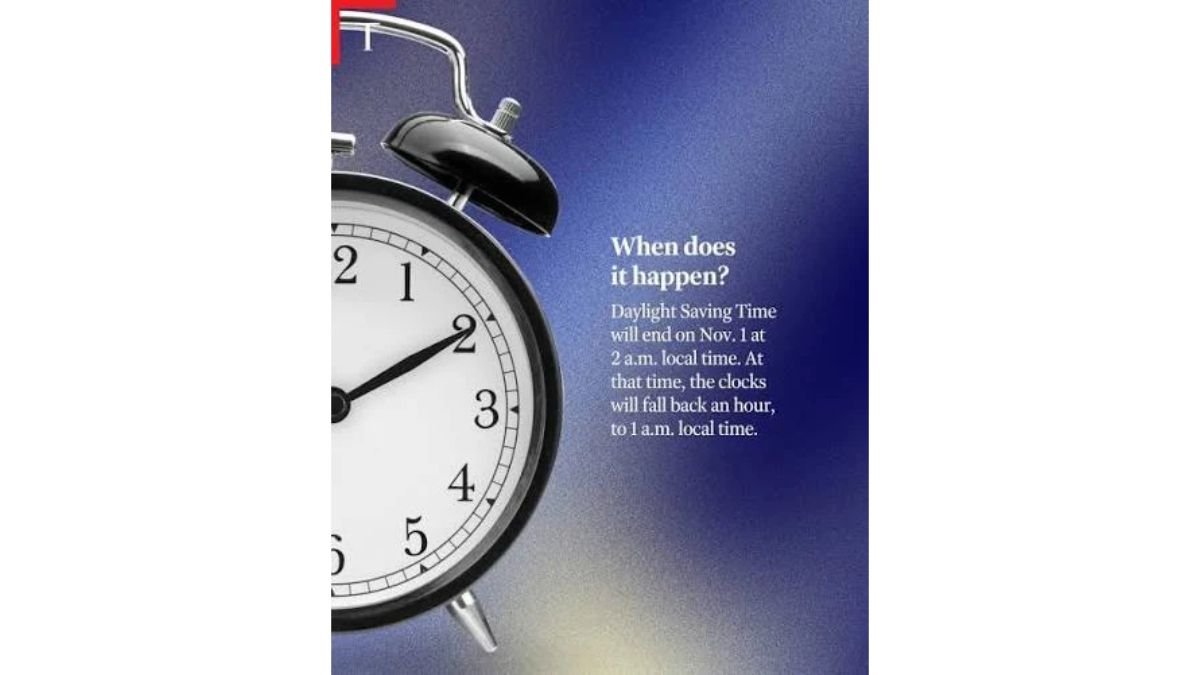
If you are checking whether daylight saving time has ended, the answer depends on your local clock. In most of the United States, clocks move back one hour at 2 a.m. on Sunday, November 1, 2026.
If that change has already happened where you live, you are now on standard time. If it is still Saturday evening, the switch is coming overnight.
When do clocks go back in 2026?
The November change takes place the morning after Halloween. At 2 a.m., clocks return to 1 a.m., repeating the hour. That is why people call it “falling back.” The National Institute of Standards and Technology confirms that the 2026 daylight saving period runs from March 8 through November 1.
The switch follows local time, so it does not happen everywhere in the country at the same moment. Someone in New York reaches the change before someone in Los Angeles.
For anyone with the same bedtime and morning alarm, the overnight change offers an extra hour for sleep. Sunday evening, however, will look different.
Sunset arrives about an hour earlier by the clock, while sunrise also shifts earlier. Moving the hands does not create or remove sunlight. It changes the time we attach to those daylight hours.
How can you tell whether your clock changed?
Start by comparing your devices. Most smartphones and computers update automatically when their date, time and location settings are correct.
A phone showing one time while the microwave shows another is often the first sign that the overnight switch has happened.
Before adjusting your phone yourself, check whether automatic time settings are enabled. Moving a clock back after it has already updated would leave you an hour behind.
Wall clocks, ovens, microwaves and some car displays may need a manual adjustment. Walk through the house and check the clocks you actually use, especially the alarm beside your bed and the one you glance at before leaving.
A quick check before bed can save confusion in the morning, particularly if you rely on a separate alarm clock or have children heading to an early practice, lesson or activity.
If you still cannot tell which display is right, compare it with the official United States time at Time.gov, choosing the correct time zone.
For Sunday travel, work or appointments, check the time shown by the airline, employer or organizer. If an overnight arrangement falls within the repeated hour, confirm which occurrence is intended.
Which places skip daylight saving time?
Hawaii and most of Arizona stay on standard time throughout the year. American Samoa, Guam, the Northern Mariana Islands, Puerto Rico and the United States Virgin Islands also skip the seasonal change, according to the Department of Transportation.
Arizona has an exception: the Navajo Nation observes daylight saving time. That matters when checking local times or arranging a call with someone in the region.
For places that follow the seasonal schedule, standard time continues through winter. The next spring change is scheduled for March 14, 2027, when clocks move forward one hour, according to Arizona’s published schedule.
For now, the useful check is simple: confirm your location, compare a trusted clock and adjust any displays that still show the old time. Once those agree, you can set your Sunday plans without wondering whether you are running early or late.